
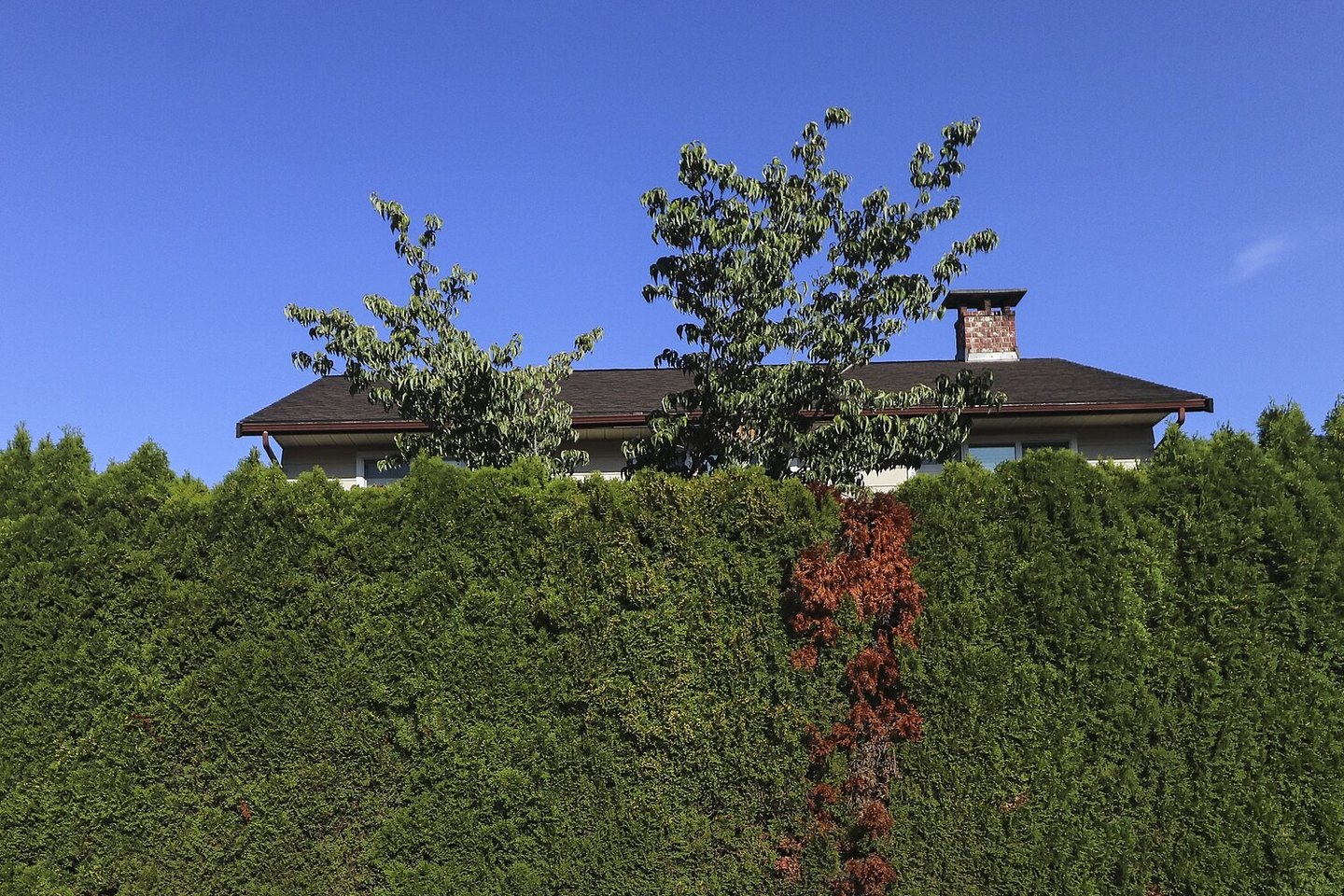

Mid-city houses
Thompson streets are detached houses, asphalt, with garages and the occasional chimney. The valley between the garage and the house is the first place to look if the stain is on that side. You can see it from the drive.
A low roof over a sunroom or a rear addition holds water longer than the gable. If the wet room is under that lower piece, say so. The gable can be fine.
Some roofs were replaced recently and still match. One stain on a matching roof is a detail. Say the colour is even.
Rain and leaves
Leaves, not pine needles, are the gutter problem unless a cedar was planted in the yard. Overflow stains the wall and the ceiling edge. Check the trough before you call the shingles finished.
Wind is ordinary city wind. You will not usually find the ridge in the yard after a storm. You will find a cracked boot or a tired flashing.
Summer sprinklers can wet the bottom courses. Mention them if they reach the shingles.
The call
Thompson and the street. Then the room. Then even shingles or pale shingles.
A narrow side yard or a locked gate is the obstacle. Say so.
Photos from the ground of the eave and the ceiling. Stay down.
Around the house
Thompson sits between busier roads. The house on the quiet crescent and the house that backs onto a busy street wear differently. Dust and wind on the busy side, leaves and shade on the crescent. Say which side the wet room faces.
A sunroom with a low roof is easy to forget because the gable looks fine from the sidewalk. Step into the yard and see if a flat piece sits over the room that stains. That piece holds water. The gable may not be the leak at all.
If the house is a strata townhouse tucked among the detached houses, say strata. The roof may be shared, and the person who can approve the work may not be you.
Thompson houses that back onto a lane have the useful view of the roof from that lane. The gutter, the valley, and the neighbour's fence are all there. If you have not walked the lane, do it once before you call. You will see whether the trough is full. A full trough and a stain at the wall can be fixed from the ground. An empty trough means the water is above it.
Thompson sits between busier roads and quiet crescents. A house on the crescent takes shade and leaves. A house against the busy road takes dust and a little more wind. The wet room is on one of those sides. Say which. A sunroom with a low roof is easy to miss from the sidewalk. Step into the yard. If a low piece sits over the room that stains, that piece is holding water and the gable may be fine. If the home is a townhouse among the detached houses, the roof may be shared. Say that. The person who can approve someone going up may not be the person who sees the stain. The description of the ceiling can still happen today. A full gutter, seen from the lane, can be the whole problem. An empty gutter means the water is above it.
A house that backs onto a lane shows its roof edge there. Walk it. You will see a sagging gutter or a valley full of leaves, or you will see neither. Neither, with a wet ceiling, means the opening is higher, usually a vent you can name by the room. Thompson is flat. There is no hill for snow to slide, and snow does not stay. Talk about rain. If a strata path runs along the side of a townhouse, say path. People use it.
Busy road or quiet crescent. Dust, or leaves. The wet room faces one of them. A low sunroom is the piece people forget because the gable looks fine from the sidewalk. Go into the yard and see if the stained room has a low roof of its own. That roof holds water. The gable may not be involved. Townhouses tucked on these streets may share a slope. Say if you cannot approve a visit on your own. The ceiling can still be described. A lane view of the gutter, full or empty, is the other half of the picture.
The crescent and the busy road wear differently, and your wet room faces one of them. Dust on the busy side, leaves on the quiet side. A low roof over a sunroom is invisible from the sidewalk and obvious from the yard. If that room is wet, the low roof is the suspect and the gable can be left alone. Shared townhouse roofs need the person who can say yes. You can still describe the stain. The lane shows the gutter. Full means start there. Empty means the water is coming from higher up.
Window first. Does the wet room face the busy road or the crescent. Then go outside and see if that room has a low roof the sidewalk cannot show you. A sunroom roof holds water the gable sheds. Townhouses on these streets may share the slope. Say if you are not the person who can approve someone going up. The lane still shows whether the gutter is full. Full is a gutter job until a cleaned gutter leaks again. Empty is a roof opening.
Busy road or crescent, seen from the wet window. Then check the yard for a low roof over that room. A sunroom holds water the gable does not. Shared slopes need the person who can approve access. The lane shows the gutter, full or empty, and that chooses gutter or roof.
Face the wet window and say road or crescent. Then look in the yard for a low roof over that same room. Sunrooms hold water. Shared townhouse roofs need someone who can approve the access. The lane gutter, full or empty, tells you whether to start with the trough or with the roof.
Road or crescent from the wet window. Low roof in the yard if that room has one. Shared roof if you cannot approve access alone. Gutter in the lane, full or empty.
A low sunroom roof is easy to miss from the sidewalk and obvious from the yard. Check before you describe the gable.
The wet window's direction is the first fact. The low roof is the second.
A sunroom roof can be wet while the gable stays dry.