
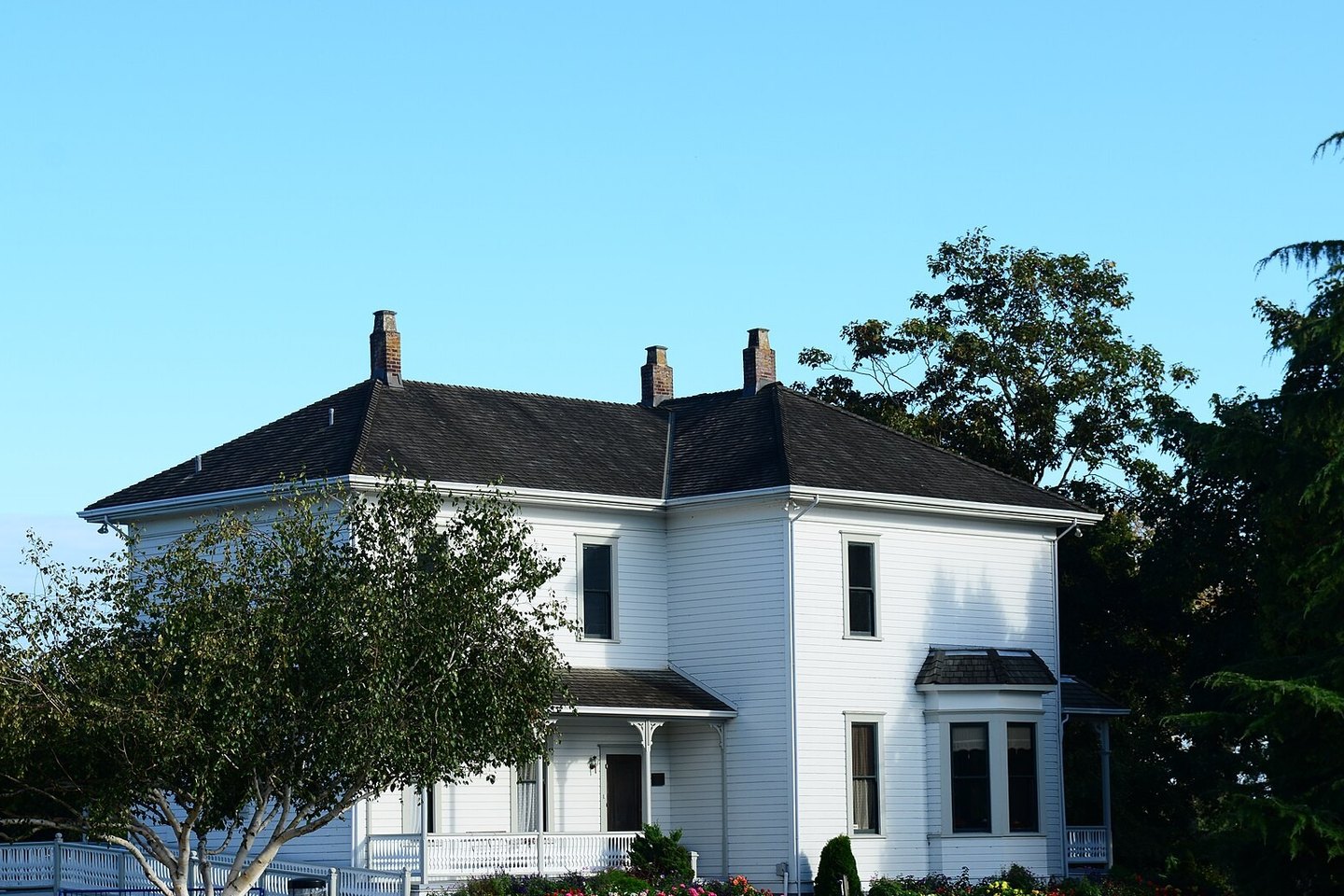

Established streets
Blundell houses have been here long enough for a first roof to be tired and a second roof to be middle-aged. Asphalt is what you see. Chimneys and vents are both common, depending on the age of the house. Match the stain to the piece.
A porch or a carport tied into the wall leaks at the joint. The main gable can look fine from the sidewalk. Say porch if that room is wet.
A lane garage is its own roof. Say garage if the drip is over the car.
Trees and rain
Maples and other street trees fill the gutters every autumn. The overflow runs down the wall. It looks like a failed roof until you look in the trough. Needles matter only if a conifer actually overhangs your slope.
The south slope goes pale and sheds grit. The north slope stays darker and, in a wet spring, a bit green. You can see both from the lane. Say which one is above the wet room.
Sprinklers in summer hit the lower courses on some lots. A daily spray rots the edge. If the wet wall is the one the sprinkler hits, mention the sprinkler.
Keep it ordinary
Blundell and the street. These are flat city lots. A ladder stands on the lawn or in the lane.
Tar at a chimney means a past patch that did not hold. Say tar.
Photos from the sidewalk and the room. Stay off the roof.
Around the house
Blundell has lanes, and the lane is where you see the real edge of the roof. The front is a tidy gutter. The lane may be a garage roof, a sagging trough, and the neighbour's fence. If the wet wall faces the lane, say lane. The repair starts there.
Houses that have had a second storey added show a horizontal line in the siding. Water at that line stains the upper corners. It is not the same as a vent in the middle of the ceiling. If your house was given an upstairs, say upstairs.
A maple that belongs to the boulevard is still your gutter's problem. You do not have to cut the tree. Say it overhangs.
Blundell roofs are close enough to the ground on the bungalows that the first course is visible from the lawn. Look for curled tabs and a fat edge. A fat edge is two layers. Curled tabs are one tired layer. Say which you see. The two-storey houses hide the first course behind the gutter. Then the symptom that matters is the ceiling and the downspout. Grit at the bottom of the spout is the slope wearing out.
The lane is the useful side of a Blundell house. The front gutter can look tidy while the lane gutter sags and the garage roof drips. Walk the lane once. If the wet wall is that side, say lane. A bungalow shows you the first course of shingles from the lawn. Curled tabs and a thick edge are visible there. A thick edge means more than one layer. Curled tabs on a thin edge mean the layer you see is tired. A second storey added later shows as a line in the siding. Water at that line stains the upper corners of the rooms. It is not the same mark as a circle in the middle of a bathroom. If the house gained an upstairs, say so. The boulevard tree is still your gutter's problem in October. You do not have to cut it.
A carport tied to the house is a low roof beside a gable. Rain sits on the carport and runs at the wall. If the drip is over the car, say carport. The gable can wait. Many of these houses have a hatch in a bedroom closet. If you have never found one, say so. The roofer will not count on an attic view. A photo from the lane of the gutter and a photo of the stain are the right preparation. Stay on the ground.
Bungalows show their age at the edge you can see from the grass. A fat edge is an older layer still underneath. A thin edge with curled corners is one layer that is done. Two-storey houses hide that edge behind the gutter, so the downspout and the ceiling do the talking. Grit in the spout, pale tabs if you can glimpse them from the lane, a line in the siding where an upstairs was added. That line stains the upper corners. A circle in a bathroom is a different opening and should be named as the vent, not as the seam.
From the grass in front of a bungalow you can see whether the edge is fat or thin. Fat means an older layer is still there. Thin and curled means the layer you see is finished. From the lane you see the gutter that actually overflows, which is often not the tidy one on the street. If an upstairs was added, the horizontal line in the siding is where water gets in at the upper corners. A round mark in a bathroom is the vent instead. Say which mark you have. The lane is also where the ladder belongs when the street side is a sidewalk.
Lane first on these blocks. The street gutter can look fine while the lane gutter overflows onto the wall that is actually stained. A bungalow lets you judge the edge from the lawn: thick, or thin and curled. A two-storey house asks you to use the spout and the ceiling instead. An added upstairs shows as a line in the siding and stains the top corners. A round bathroom mark is the vent. Say the mark you see. When the street is a sidewalk, the lane is where the ladder should stand.
Lawn edge on a bungalow: thick or curled. Lane gutter: the one that actually overflows. Added upstairs: a line in the siding and stains at the top corners. Bathroom circle: the vent. Sidewalk in front: put the ladder in the lane. That is the whole walk-around.
Bungalow edges are visible from the lawn. Two-storey edges are not, so use the spout and the ceiling. The lane gutter is the one to trust. An upstairs addition stains the top corners along a line in the siding. A bathroom circle is the vent. Put the ladder in the lane when the front is a sidewalk.
Lawn for a bungalow edge, lane for the real gutter, ceiling for the mark. Thick edge, curled edge, upstairs line, or bathroom circle. Say the one you see, and use the lane for the ladder if the front is a sidewalk.
Trust the lane over the front view. The mark on the ceiling tells you whether it is the edge, the seam, or the vent.
The ceiling mark and the lane together are enough to aim the visit.
A thick edge and a curled edge are different layers of work.