
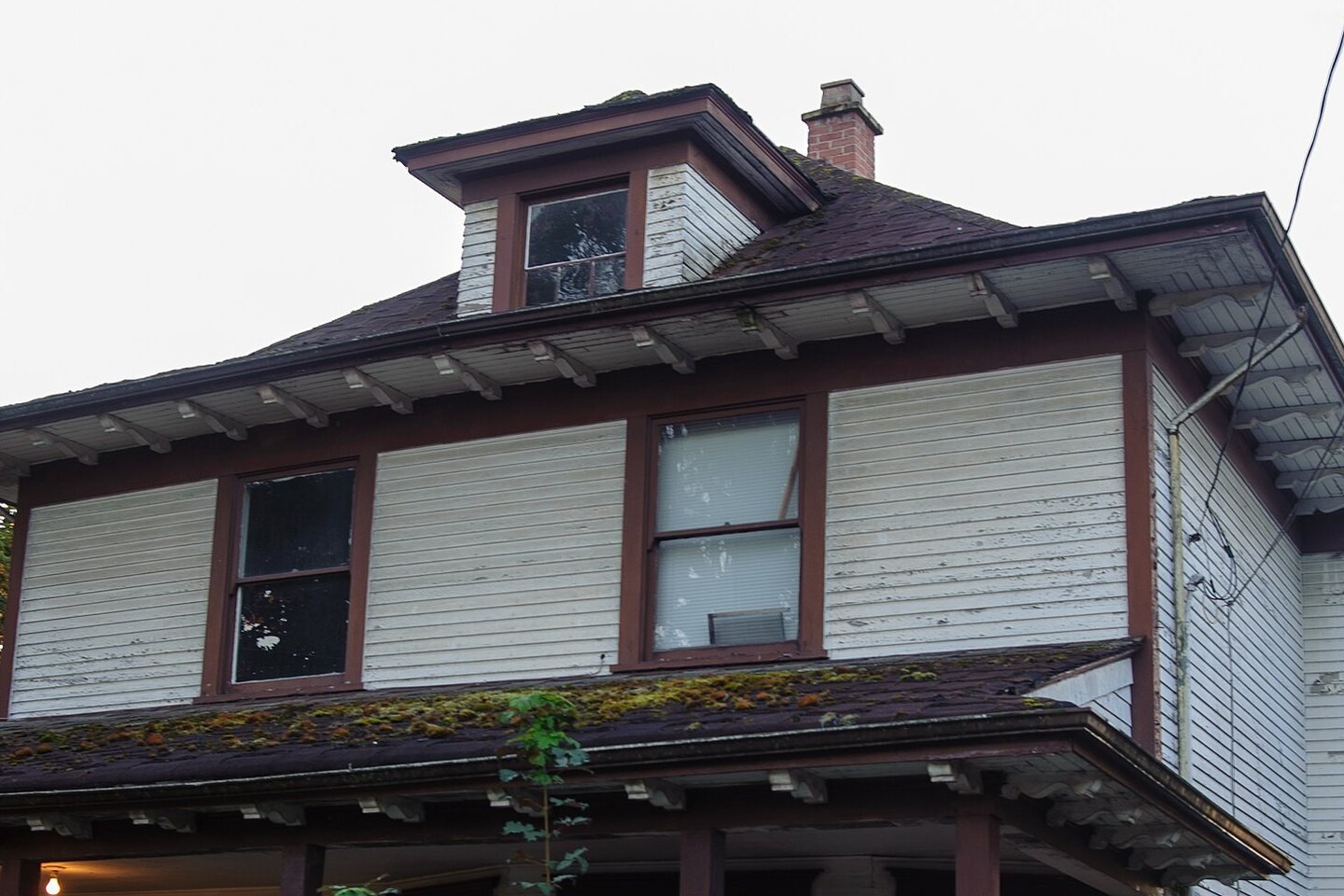

South Richmond houses
Shellmont is detached houses and some townhouses on quiet streets. Roofs are gabled asphalt. An attached garage creates a valley. If the stain is in the garage ceiling or the bedroom beside it, say valley.
Townhouses share a roof and a step of metal between units. If the stain is on a shared wall, say shared wall. The repair may involve the next unit.
Older roofs have lost their colour on the sunny slope. You can see the grit in the downspout from the driveway. Newer roofs on the same street should not be described the same way.
Rain, not snow
Richmond winters are rain. A leak is weeks of water finding a crack, not ice at the eaves. A rare cold morning can leave a slick on the walk. It does not sit on the roof the way it does in the interior.
Street trees drop leaves into the gutters in the fall. Overflow down the siding looks like a roof leak. Empty the trough and watch one rain. If the mark returns, the water is coming through the roof.
Where a lot backs onto a field or a park, there is more wind. Edges can lift. Most Shellmont yards are sheltered. Describe the yard you have.
A straightforward call
Shellmont and the street, so this is not treated as Steveston. Then the room. Then young roof or tired roof.
Say if a fence or a parked car blocks the wet wall. The driveways are ordinary.
Photos from the driveway and of the ceiling. Do not climb.
Around the house
Shellmont streets were built as family lots, so the roofs stay simple until a renovation complicates them. A covered deck on the back is the usual complication. Water gets in at the ledger and shows up in the room behind the glass. Say if the deck roof is newer than the house.
The neighbourhood is inland of the harbour. Do not describe a Shellmont roof as a Steveston roof. The wind is lighter, the trees are street trees, and the leak is a valley or a vent more often than a lifted edge.
School-run parking fills a few crescents. If the driveway is the only place a truck can sit, say that.
A townhouse in Shellmont and a detached house on the next street do not share a roof. The townhouse has a shared slope and a strata. The house has a yard and a gutter you can look into. Say which you live in before you describe the stain. Most of these roofs are young enough that grit in the downspout is a surprise. If you see grit, say so. It means that one slope is further along than it looks from the colour.
Shellmont is houses, not the harbour. A dark roof and one wet room is a vent, a valley, or a skylight. Walk the driveway and see if the garage meets the house in a valley you can look into. Leaves there hold rain against the laps. If the bedroom beside the garage is the wet one, you have found the place from the ground. These streets were built as family lots. A deck added later is the piece that leaks at the wall, while the main gable still looks even. Say deck if the room behind the glass is the one with the mark. Grit in the downspout, on a roof that still looks young, means that one slope is further along than the colour suggests. Say if you see the grit. The truck parks in the driveway. School mornings fill a few of the crescents. Say if the driveway is the only place it will fit. You do not need to move the bins before you call.
Look at the downspout after a storm. A little pile of coloured grit means the shingles are shedding. No grit, and a stain in one room, means one opening. Shellmont has both on the same street. Do not let a neighbour's new roof decide yours. If a hedge sits on the drip line, say so. Falling grit stains it, and a cover is easier than cleaning the leaves of a cedar. The visit can start from a photo of that hedge and a photo of the ceiling.
Family streets here have simple gables until someone adds a deck or a garage. The deck leaks at the wall behind the glass. The garage leaks in the valley you can see from the drive. Stand there and look. Leaves in the valley, or a clean valley and a stain anyway. Clean means the opening is a pipe or a skylight, not the debris. Coloured grit at the bottom of a downspout is the shingles wearing, even if they still look fairly dark from the street. Say if you see that pile. It changes the conversation from a patch to the slope.
Coloured grit in the downspout is the slope aging. A clean spout and one wet room is a single opening, usually where a pipe comes through or where the garage meets the house. You can see that meeting from the driveway. Leaves packed into it hold water for a day after the rain stops. If a cedar hedge sits under the eave, say so before anyone strips a slope. The grit stains the hedge. A photo of the hedge and a photo of the ceiling are enough to start, and you can take both without a ladder.
Driveway first. The valley where the garage meets the house is either full of leaves or it is not. Full means the water is being held there. Empty, with a stain in the next room, means a pipe or a skylight. Grit at the spout means the slope is shedding its surface. A hedge under the eave is a reason to catch that grit. None of this needs a ladder. School mornings crowd a few crescents, so the driveway is the place to put a truck. Say if a bin or a boat already fills it.
Driveway valley, full or empty. Full is leaves. Empty, with one wet room, is a pipe or a skylight. Grit in the spout means the surface is wearing. A hedge under the drip is a reason to catch it. The driveway is also where the truck sits when the crescent is full of school traffic.
The driveway shows the valley. Leaves in it, or a clean valley and a stain anyway. Grit in the spout is wear. A hedge under the eave should be mentioned so the grit does not end up in it. When the crescent is full of cars in the morning, the truck uses the driveway. Say if something is already parked there.
Valley at the driveway, grit at the spout, hedge under the drip. Those three, plus the one wet room, are a complete Shellmont call. The truck can use the driveway when the crescent is busy.
One wet room on a dark roof is a small opening. Grit in the spout means that slope is further along than it looks.
A dark roof and one room should not be treated as a worn-out slope.
Leaves in the valley are a different call from grit in the spout.